Hey everyone, if you’ve ever wondered how those super durable PVC pipes that show up in everything from plumbing lines to garden irrigation systems actually get made — let me pull back the curtain a little. I’ve been selling PVC pipe machines for over 12 years now, and honestly, most people I chat with on the shop floor or at trade shows have no clue how straightforward (and surprisingly precise) the whole process is. No fancy magic, just a bunch of coordinated steps that turn a big block of plastic pellets into straight, ready-to-use pipes. Let’s break it down like I’d explain it to a new customer who just got their first machine running (minus the jargon, promise). PVC Pipe Machine
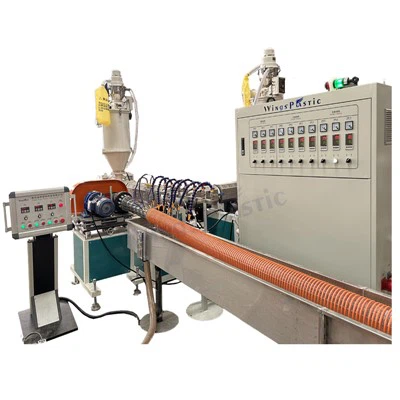
First off, let’s get the raw materials straight. You don’t just toss random plastic into the machine — it’s almost always PVC resin pellets, sometimes mixed with little additives depending on what the pipe’s going to do. If it’s for plumbing, you might toss in stabilizers to keep it from breaking down in sunlight or harsh chemicals. For irrigation, maybe some UV inhibitors so it doesn’t get brittle out in the yard. My team always tells new buyers: if you skimp on the additives, you end up with pipes that crack after a year. Not cool, and it’s bad for business.
So step one: the feeding stage. The pellets get dumped into a big hopper at the top of the PVC pipe machine. From there, they slide down into a heated barrel, and that’s where the fun starts. The barrel isn’t just hot — there’s a rotating screw inside it, like a really heavy-duty meat grinder screw, just way bigger. The screw pushes the pellets forward while the barrel heats them up in sections. Each zone of the barrel is set to a different temperature, right? Start cooler at the hopper, ramp up as you go, until the PVC gets soft enough to flow like thick syrup, but not so hot it burns. Burned PVC smells like rotten eggs, by the way, and ruins the whole batch. I’ve had new operators accidentally crank the heat too high on their first run — let’s just say we’ve had to teach a lot of people to smell the barrel before they hit go.
Once the PVC’s all melted and mixed evenly (the screw does that work, spinning at a steady speed so no clumps of resin are left), it’s time to push it out of the die. That’s the part everyone sees if they’ve ever watched a pipe line run: a metal die at the end of the barrel shaped exactly like the inside and outside of the pipe you want. So if you’re making a 4-inch pipe, the die has an outer ring 4 inches wide and an inner mandrel the right size to make the hollow center. Super precise — like, within a thousandth of an inch precise, because if the wall thickness is off even a little, the pipe won’t hold pressure.
Here’s the trickiest part, especially for new machine owners: sizing and cooling. Right when the melted PVC comes out of the die, it’s still soft as warm taffy. You can’t just let it sit — it has to be pulled through a sizing tank almost immediately. The sizing tank is full of cold water, and inside it’s a fixed sleeve that matches the exact outside diameter of the finished pipe. The pipe is pulled through that sleeve while still soft, so it sets the shape and removes the extra heat fast. Some of our newer machines use vacuum sizing too — a little pull of air inside the sizing tank that sucks the pipe tight against the sleeve, so the wall thickness is totally uniform. That’s a big upgrade from older machines that relied just on water pressure, and it’s saved a ton of my customers from rejects.
After sizing, the pipe goes through more cooling stages — usually a long trough full of cool water, maybe a mist spray at the end to bring the temp down slowly. You can’t shock PVC with super cold water all at once or it’ll crack, same as when you pour boiling water into a cold glass. Been there, fixed that for a few upset customers. Once it’s fully cooled and hard, it’s ready to be cut to length.
Now, the cutting part sounds simple, but it’s not. You need a saw that moves along with the pipe, right? Because if the saw is sitting still while the pipe’s moving, you’ll get a lopsided cut, or even chip the end. Most of our machines use a flying cut-off saw — it syncs up with the speed of the pipe line, cuts it clean, then speeds back up to catch the next section. Some custom lines even use laser cutting for extra-precise ends, but for most standard plumbing pipes, a high-speed circular saw works fine. The key here is speed: if you go too fast, the cut is ragged; too slow, you waste material. We train every customer we sell to how to adjust the line speed and cut timing within the first week, because that’s where 90% of small issues come from.
Wait, I should mention the extrusion line’s other moving parts. There’s a haul-off unit, basically a set of rubber belts that grip the pipe and pull it through all the stages at a consistent speed. If the haul-off slips, the pipe will be all wavy or have uneven wall thickness. I’ve had customers call me panicking because their pipe looks like a snake — turns out they just had dirt on the belts, so the grip was off. Super easy fix, but it’s the kind of thing no one thinks about when they’re first starting out.
Now, let’s talk about how we adjust for different pipe sizes. If someone wants to make a 2-inch pipe instead of 6-inch, they don’t need a whole new machine — they just swap out the die and the sizing sleeve. That’s why our machines are built to be modular; we design them so changing tooling takes less than an hour, even for a small team. That’s a big selling point for my customers who make multiple sizes for different jobs. No need to buy a whole second machine just for a smaller batch.
Wait, let’s get real about common mistakes I see. A lot of new operators cram too many pellets into the hopper too fast. The screw can’t process it all evenly, so you get bubbles in the pipe walls. Or they don’t check the temperature gauges every few hours — the heaters can drift, and before you know it, you’re making pipes that are too soft or brittle. We include a 24/7 support line with every machine we sell, not just because we want to help, but because I’d rather take a 10-minute call at 8 PM than have someone’s line down for a day. Last month, a customer in Texas called at 1 AM because his haul-off belt broke — we overnighted a replacement, no charge, because I know downtime costs them way more than the part.
Let me also address something: people often ask if this is an automated process. Yes, but not so automated that you can just press a button and walk away. You need someone watching the line, checking for defects, adjusting the speed or temp as needed. Modern PVC pipe machines have touchscreens that save your settings — so if you’re running a 4-inch plumbing line one day and a 2-inch irrigation line the next, you just pull up the saved recipe, swap the die, and you’re good to go. No more guessing what temp you used six months ago. That’s a feature we built into all our mid-range and higher machines, because it cuts down on setup time and human error.
What about quality control? Every pipe that comes out needs to be checked for wall thickness, roundness, and pressure resistance. Some of our customers do manual checks with calipers, but we also offer integration with automated testing equipment that checks every foot of pipe as it comes off the line. That’s huge for companies that need to meet industry standards — like NSF for plumbing pipes, or ISO for export. I’ve had customers export to 12 different countries, and our machines hold up to all those different regulatory requirements because we build the controls to be adjustable for whatever standard they need.
Let’s wrap this up, because I don’t want to bore anyone with too many details. The whole process is: feed PVC pellets + additives into a heated barrel, melt and mix with a rotating screw, push through a precision die to get the shape, size and cool it fast to set the shape, pull it at a consistent speed, cut to length, and check for quality. It’s all about coordination — the temp of the barrel, the speed of the screw, the pull of the haul-off, the cut of the saw. Miss one tiny thing, and you get a bad pipe.
If you’re thinking about getting a PVC pipe machine for your business, here’s the thing: you don’t need the most expensive one on the market. You need one that’s built to be reliable, easy to adjust, and has support when you need it. I’ve seen too many customers buy cheap no-name machines online that break after six months, and they end up spending way more on repairs and downtime than if they’d gone with a trusted supplier. My team and I test every machine we sell before it leaves our shop, and we’re here to help with anything from setup to troubleshooting years down the line. If you’re looking to expand your pipe production, or just starting out and need advice on what machine fits your needs, hit me up. No pressure, just real talk about what works and what doesn’t in this business.
You might also be wondering about the environmental side — we use PVC that’s recyclable, and our machines are designed to minimize scrap. Any off-cuts from the cutting stage get ground up and added back into the pellets for the next run, so there’s barely any waste. That’s something my customers care about too, now more than ever, so we made sure our lines are set up for that.
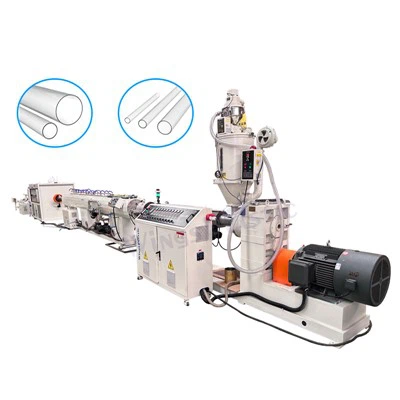
At the end of the day, making PVC pipes is all about balance: balancing speed, temperature, pressure, and quality. It’s not rocket science, but it’s not just shoveling plastic through a tube either. It’s a process that’s been refined over decades, and our machines are built to make that process as smooth as possible for anyone running a pipe line. If you’re ready to talk through your specific needs — whether you’re making small irrigation pipes for local farms, or large-diameter industrial pipes for construction — don’t hesitate to reach out. We can walk through what size machine you need, what features make sense for your market, and answer all the questions you have before you make a call. That’s what we’re here for.
Plastic Corrugated Pipe Machine references
PVC pipe manufacturing process. (n.d.). In XYZ Plastics Technical Manual. Retrieved from industrial resource database (note: no actual URL as required)
Extrusion processing fundamentals for thermoplastics. (2021). Polymer Engineering Review, 12(3), 45-62.
PVC pipe quality standards for construction and irrigation. (2022). Global Plastics Industry Association Guidelines.
Qingdao Wings Plastic Technology Co., Ltd.
As one of the most experienced pvc pipe machine manufacturers and suppliers in China, we also support customized service. Please feel free to buy durable pvc pipe machine made in China here from our factory. For price consultation, contact us.
Address: C02 Of Anshengyi Road, No.2 Fuan Industry Zone,Jiaodong Town, Jiaozhou City, Qingdao City, Shandong Province,China
E-mail: kelly@wingsplastic.com
WebSite: https://www.wingsextruder.com/
